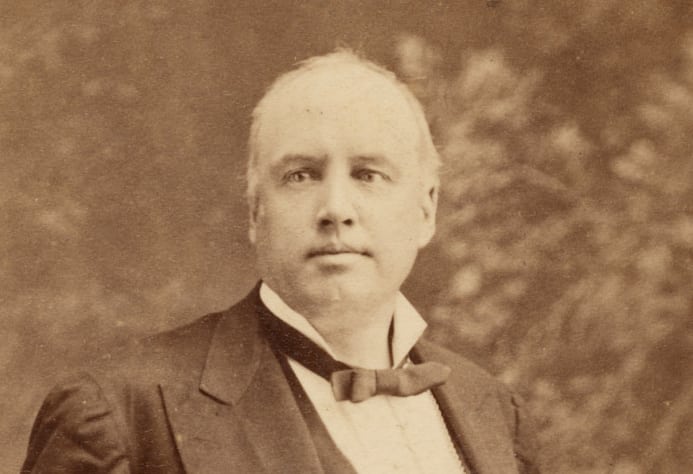

Though not a Spiritualist, nor believer in an afterlife, Robert G. Ingersoll shared common ground with them and spoke at various gatherings of Spiritualists. Here he speaks of that relationship via the trance medium Cora Richmond at a Spiritualist Camp Meeting In Missouri in 1899:
I have heard it said in this convention and in many, councils of Spiritualists while I was still on earth, that had I been true to my convictions I would have avowed a knowledge of spirit life and spirit communion. I did not know of it. I knew what Spiritualists think, I knew what they believe, I knew that there were many of them honest and true to their convictions. I spoke upon their platforms and in their camp-meetings, because we were engaged in a common cause, viz.: That of breaking down the errors and bigotry of a blind theology, but I did not know concerning the future life.
Ingersoll relates his experience at the moment of death, noting various elements that closely align with reports from near death experiences.
Viewing the body from outside
“Oh!” I said, “is that you, that thing that lies there helpless and without possibility of speech or heart-throb, or language, or affection; is that the boasted thing that you called yourself lying there now so prone, so powerless?”
Seeing the light
“Suddenly in the midst of the great, solemn silence of death, in the midst of the whirling thoughts that went surging through the brain into a shadowy something unknown, in the midst of the pulsing tides of affection that sought to reach the loved ones who were left behind, in the midst of this which shut off the mortal breath came the surpassing glory of spirit life. This sun of splendor rose suddenly, clear and cloudless, there was nothing that could mar its beauty or its perfection and sweet strains of music, like those that Apollo might have given on his harp of light among the stars, floated toward my consciousness and seemed to upbear me from the mortal thought.”
Greetings from loved ones
“Wonderful thoughts came pulsing like argosies of light freighted with dreams of prophecy and hopes of immortality, and these bore the images of loved ones whom I had known in childhood, those who had gone into the white silence of death and from whom I had heard no more. They came toward me, not as strangers, but as those who were aware of my coming and hastened to welcome me.”
Intensified perceptions
“Instead of fading when the senses faded, it seemed to me that every pulse was quickened, every nerve was performing it thousandfold more duty. I could hear the voices of the loved ones saying softly and with hushed and tremulous voices, “Is he really dead?” I could also hear their hearts beat and feel the throbbings of their minds as, with great intensity of love; they asked the man of medicine if he could cure me.”
Life review
“It seemed to me that the chain of thought was limitless; it seemed to me that retrospect and prophecy were one; it seemed to me that all the things that I saw or did were before my consciousness, and each unworthy, act burned into my spirit with a bitter pang, and much that I had done was brought to my consciousness with added joy, for there were those who seemed to think I had done them good. Whomsoever I had helped in any way came toward me with added love, and upon whomsoever there had been bestowed a benefaction, even with my feeble earth hands and brain, that benefaction seemed doubled a thousand fold.”
In a separate talk given exactly a year later in 1900, Ingersoll confirms that he remains neither in the Heaven of theology or in Hell.
“I have not smiled down from parapets and towers made of precious stones, nor from those streets of gold, nor from the midst of those fountains flowing with milk and honey, upon souls in torment and torture. I have not been glad that I was one of the saints to be saved and that most of my friends were to be lost. No such heaven has received me.”
At the moment of death
“So when it finally came I wished to watch every emotion, every pulsation, every throbbing thought before the mind sunk away into that forgetfulness, which I thought might be the Lethean stream from which I would never awaken.
“To my great surprise, with the shock that carried me off I felt the gateways of my being unloosen, and I felt as I have sometimes felt when watching the dawn, when Aurora, with her attendant beams, glides up the heavens and one by one unbars the gateways of the dawn for Phoebus, the god of day.”
The rapture of death
“I have never experienced so great a rapture as that which came to me because of death, the surpassing freedom of the consciousness that thought is eternal; that not one of these fairy children of the brain would be lost; that not one of these hopes and imaginings for human life would be destroyed; that not one of all those whom I had loved was missing in this goodly company that gathered to receive me.”
Grief as a barrier
“…after the great first flash of the awakening, after the great first consciousness of being free, of this which had come to me, of a new birth, and a new awareness of what that birth meant, there came a change: Then I, too, was immersed for a time in grief. A sudden change came over me, a sudden recollection that they did not know me, a sudden consciousness that those whom I had loved could not see me, nor hear me, nor speak to me, nor be aware of my existence. I moved among them a being unknown. The awful barrier of the great human grief, the one inevitable sequence of human blindness to spiritual presences, had separated me from them and them from me.”
One world at a time?
“…one world at a time is enough for me, but it must mean all the world, not a part of it; the entirety of existence…it must be all of that which is within, around, beneath and above as well as that which is in the conscious human sentient being and frame that you now possess.”
Where am I?
“Where am I? No limited space enchains me, no walls encompass me around about, no dim labyrinths of terror mock me, no limit appears before my vision. I feed upon the nectar and ambrosia of the gods.”
There is no ‘was’
“Alas! too often the dear ones fold the memory away, as carefully and sacredly as a lock of hair, or a keepsake, a sacred treasure trove at the altar of love, and say, ‘how good he was.’ There is no ‘was.’ It is: life is eternal, it is now, it is endless, it is indestructible, it is continuing to unfold, it will be the bearing of the message unto all eternity.
Read the full address Colonel R. G. Ingersoll Not in Hell given August 5th, 1899.
Read the full address Where Am I? In Heaven or in Hell? given August 5th, 1900.